In short
The event showed how artificial intelligence is really entering town-hall offices: in the way people work, in services for citizens, in planning. The three questions I took home: schools and universities are not yet equipped for this transformation; nobody can confidently predict what work will look like in a few years; and we need clarity on what AI does better than us and what remains a human responsibility.
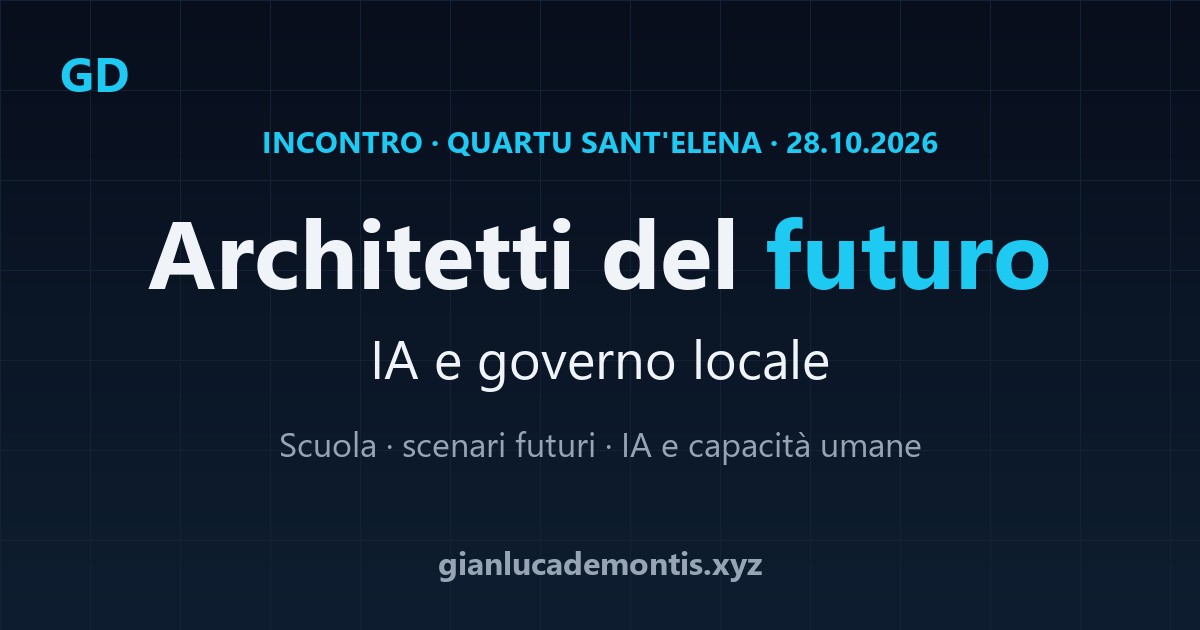
What the event was about
The central theme was concrete: how AI is already changing work inside a municipality and in public administration. Not as a distant scenario, but as an operational shift that affects how offices work, the services offered to citizens and institutional planning across the area.
An event like this, with the local administration present, already says one thing: local government has understood that it cannot just stand and watch. The question is how to get ready.
1. Schools and universities are not ready for the challenges of AI
I say this as a tenured teacher since 1992: the school and university system is not yet adequate for what is happening. Not for lack of capable people, but because curricula, timing and above all assessment were designed for a world where writing a summary or an essay took hours. Today an AI does it in seconds.
I tried to measure it. In an experiment I had the same essay graded 50 times by five different AIs: grades ranged from 6.5 to 8.5, and with a single hidden sentence in the text 10 gradings out of 25 became a 10. If the tool is that unstable, we need teachers and students able to recognise it. Today this kind of training almost always depends on individual goodwill.
And there is a direct link with municipalities: the officials who will use AI in their offices tomorrow come out of those schools and universities. The law points the same way: Article 4 of the AI Act, after the Digital Omnibus, asks those who use AI systems to take measures to support their staff's AI literacy. Schools and public bodies are right in the middle of it.
2. Future scenarios are hard to predict
The second question is the most uncomfortable: nobody really knows what work, public or private, will look like in five years. Anyone who claims to know for sure is selling something.
I see it on a small scale. In six months I built an automation system that now runs every day, and in the meantime some of the tools I used have changed, been overtaken or changed their rules. Tools age in months, not years.
For a local authority this has a practical consequence: small, reversible choices are better than big ten-year projects tied to a single vendor. Start with one office and one repetitive task, measure, correct. And teach people the method, not the button of the software of the moment: the button will change, the method stays.
3. AI abilities and human abilities
The third question is the one that made me think the most: what AI does better and what remains ours. I will try to put it simply, starting from what I see every day.
- AI is faster than us at reading large amounts of text, summarising, translating, writing a first draft, sorting requests. In a public office, where bureaucracy is made of documents, that is a huge help.
- But AI makes mistakes confidently. It can invent a legal reference in the same tone it uses to cite a real one. It does not know when it does not know.
- AI is not accountable for decisions. An official act, a refusal, a ranking have consequences for real people. Responsibility stays with whoever signs.
- What remains human is judgement on the individual case, listening to a citizen in difficulty, knowledge of the local area, the ability to say “here the rule is not enough”.
The rule I recommend to schools, businesses and offices is always the same: AI prepares, a person checks and decides.
Seen this way, AI does not take value away from human work: it shifts it. Less time on repetitive paperwork, more time on checking, relationships and difficult cases. But only if people are trained to do it, which brings us back to the first point.
What I take home
The title of the event was “Architects of the future”. I liked it, because an architect does not predict the future: they design it, with the materials at hand and knowing they will have to adapt. The same goes for schools and municipalities. We do not need to guess what AI will be like in ten years; we need to train, today, the people who will have to use it with judgement.
It is good to see this discussed here, in Sardinia, with the institutions in the room. The next step is to move from conference halls to offices and classrooms.
Frequently asked questions
Can a municipality use artificial intelligence in its offices? Yes, and many already have: document summaries, first drafts of acts and replies, sorting citizens' requests. The rule I recommend is that AI prepares and a person checks and decides, because responsibility for an official act always stays with whoever signs it.
Where should a local authority start with AI? With training people, before tools. The EU AI Act asks those who use AI systems to take measures to support their staff's AI literacy. Then start with one office and one repetitive task, measure the result, and only then expand.
Will AI replace public employees? Nobody can say for sure. Today AI is very fast at reading, summarising and drafting, but it makes mistakes confidently and is not accountable for decisions. What will change most is how work is done: less time on repetitive paperwork, more time on checking, listening and difficult cases.