In short
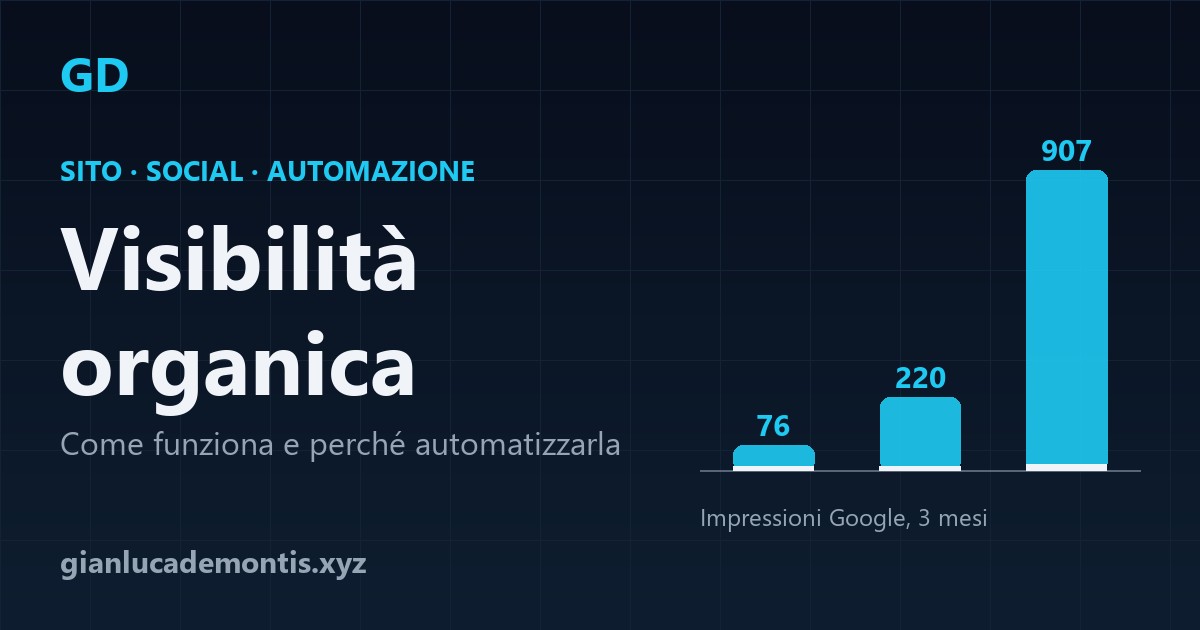
Organic visibility, the kind you do not pay for, does not come from a single post: it is the result of many small steps done every time, done well and done consistently. Over my last three 28-day periods, Google impressions went from 76 to 220 to 907, but clicks only from 7 to 18: being seen is not enough. A pipeline cannot make content interesting, but it can take it everywhere in the right format and measure what works.
Visibility is not traffic
When people talk about visibility they mix very different numbers. It is worth separating them, because every step loses people:
- Impression: the content appears on someone's screen (in Google results, in a feed).
- View or click: the person stops, watches the video, opens the link.
- Visit: they land on the website and read.
- Action: they subscribe, get in touch, buy, share.
An example from my data: in 28 days the website appeared 907 times in Google results and got 18 clicks, 2%. Impressions are a good sign (Google considers you relevant), but on their own they bring nobody.
How visibility works for a website
A search engine works in four steps, and any of them can stop you:
- Discovery: Google finds the page by following links (from your other pages or from other sites) and by reading the sitemap, the list of pages you give it.
- Crawling: it downloads the page and reads it.
- Indexing: it decides whether to keep it. This is not guaranteed: at the end of October I had about ten pages marked “crawled, currently not indexed”.
- Ranking: for each search it decides the order of results. Relevance, quality, the author's demonstrated experience, speed and mobile reading all count.
For a couple of years there has been a fifth audience: AI-generated answers (Google AI Overviews, ChatGPT, Perplexity), which read pages and sometimes cite them. Clear text with questions and answers, structured data and an llms.txt file summarising the site help them understand you. This is what is now called GEO. None of it guarantees a citation, but without it it is harder.
The key point is time: a website grows over weeks and months, not days. This is my trend:
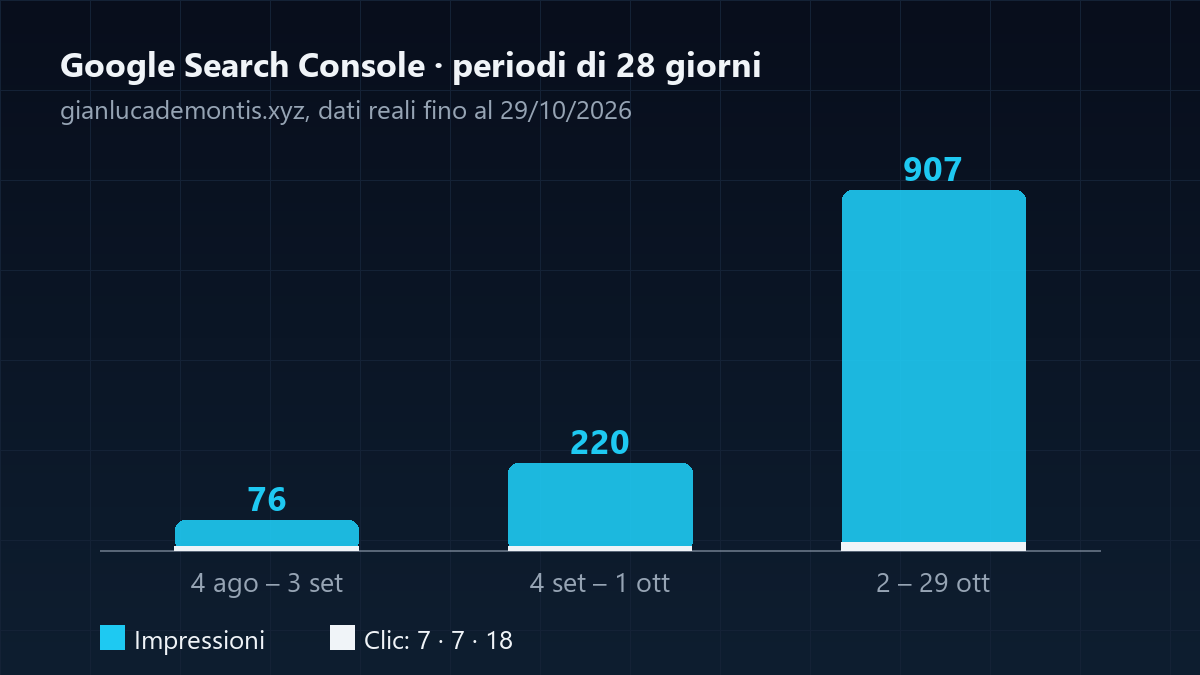
During that period I did four things: more useful, practical articles; every article in Italian, English and Spanish; internal links between related articles (the “Read also” boxes); and structured data on every page. I cannot isolate the effect of each one, but one fact is clear: impressions come almost equally from Italy, the United States and Spain. Without the translations, two thirds of that audience would not exist.
How visibility works on social media
On social media the logic is the opposite: nobody searches, the feed suggests. Platforms use different systems, but the basic pattern is similar:
- Test on a small audience: the content is shown to some of your followers and to people with similar interests.
- Reading the signals: how long people watch, whether they reach the end, whether they comment, share, save or send it privately. The “like” weighs less than you might think.
- Expansion: if the signals are good, the content moves to wider circles, including people who do not follow you. If they are weak, it stops there.
A few practical rules follow:
- Each platform rewards its own format. Short vertical videos (Reels, Shorts, TikTok) are the ones that most easily reach people who do not follow you.
- External links slow things down. Platforms want to keep you inside: that is why on Facebook and LinkedIn I put the link in the first comment and on Instagram I write “link in bio”.
- Followers are not an audience. My Facebook page has 1,254 followers, and over the last 30 days its reels got 9 plays in total. The same video on YouTube got dozens.
- The first minutes matter. The first audience decides whether the content spreads: timing and regularity make a difference.
My numbers for the last 30 days
Every Monday I get an automatic summary. This is today's, untouched:
| Channel | Numbers | Note |
|---|---|---|
| 747 views | 417 accounts reached, 662 followers | |
| Facebook (page) | 593 feed views | 9 reel plays, 1,254 followers |
| YouTube (2 channels) | 1,636 views | 18 recent videos |
| Website | 403 page views | only visitors who accept cookies: an underestimate |
| 907 impressions, 18 clicks | last 28 days available |
TikTok and LinkedIn do not offer a reading interface I can use, so I check them by hand. I take two lessons from these numbers.
One strong piece is worth more than ten average ones. The experiment in which I had AI grade the same essay 50 times got 240 views on Instagram (the month's other posts sit between 10 and 66), 647 on YouTube across both channels, and it is the most-read page on the site after the home page. It asked a question everybody cared about and had real data.
Social media and Google do two different jobs. Website visits come from social media in 72 sessions and from search in 63. Social brings a spike on publishing days and then fades; Google brings few visits, but keeps bringing them for months.
Why build a pipeline
This is what a single piece of content, done properly, requires every time:
- write the article and translate it into English and Spanish;
- update the sitemap, blog index,
llms.txtand structured data; - prepare the link preview image (1200×630), the Instagram image (4:5) and a vertical video;
- adapt the text to each platform: length, tone, hashtags, link in the right place;
- publish on five or six platforms and check it actually went out;
- after a week, collect the numbers and understand what worked.
By hand it takes half a day, and the temptation to skip a step is huge: “I'll do the translation later”, “no video this time”. The problem is that organic visibility is a consistency game: Google sees a site that keeps updating, social platforms see an active account, and the advantage builds up over time. Skipping steps means giving up exactly that build-up.
A pipeline does the repetitive part the same way every time, without forgetting anything, and leaves the decisions that matter to a person: what to say, whether the text is right, whether to publish. Mine works like this:
- Content: I write the article with help from AI and review it line by line.
- Website: a script creates the English and Spanish versions and updates sitemap and indexes; one push to GitHub and the site is live within a minute.
- Graphics: Python scripts generate the preview, the Instagram image and, when needed, a Short with voice-over.
- Social: publishing through the official Facebook, Instagram, LinkedIn and YouTube APIs; TikTok through browser automation. Scheduled posts run from a Raspberry Pi, so the PC can stay off.
- Measurement: every Monday morning the summary with views and visits arrives on Telegram, the one in the table above.
I described how the whole system came about in the case study on six months of automation, and the first version of the n8n social publisher.
What a pipeline does not do
- It does not make weak content interesting. It multiplies what is there: zero included.
- Publishing more is not publishing better. Lots of content with weak signals teaches the algorithm that your account can be ignored, and the risk of looking like spam is real.
- It needs checking. I have had a script report “published” when the video was not on TikTok. I always check live.
- It needs maintenance. Expiring tokens, API versions changing, platforms changing rules: plan for a few hours a month.
The pipeline takes the content everywhere. Whether it is worth watching remains a human decision.
Where to start, even without coding
- Measure before automating. Connect Google Search Console to your site and every Monday write down four numbers: impressions, clicks, social views, enquiries received.
- Start from the website, not the post. One solid piece a month on your site, then derive the posts for each platform from it. The other way round builds nothing that lasts.
- Write your checklist. The list of steps for each publication is already a pipeline, just a manual one.
- Automate the step you skip most often. Usually it is adapting formats or measuring.
- Use the free tools. Scheduling in Meta Business Suite, LinkedIn and YouTube costs nothing; to connect the pieces there is n8n, Make or a few scripts.
In summary
On a website, visibility builds slowly and lasts; on social media it comes in waves and fades quickly. In both cases content quality decides, but the winner is whoever manages to publish it well, everywhere and regularly. That is exactly the repetitive work a pipeline does better than a person, leaving the person time to think about what to say.
Frequently asked questions
What is organic visibility? It is the visibility content gets without paid advertising: positions in Google results, appearances in social feeds, citations in AI answers. It depends on the relevance and quality of the content, how it is published and consistency over time.
How long does it take for a website to appear on Google? A new page can be crawled within a few days, but indexing and ranking take weeks or months, and some pages are never indexed. In my case monthly impressions grew twelvefold in about three months of regular publishing.
Does automated publishing get penalised on social media? According to the platforms themselves, publishing through official tools or APIs is not penalised. What gets penalised is repetitive content, spam and fake engagement. That is why a pipeline must adapt each piece of content to the platform instead of posting the same text everywhere.